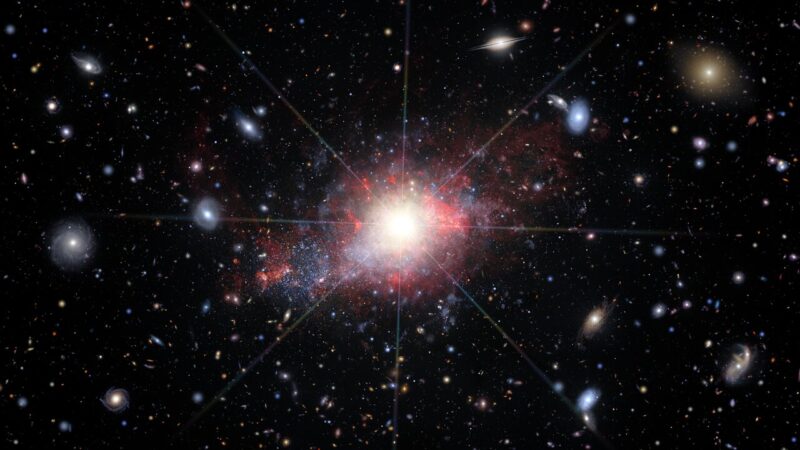
Using the Dark Energy Spectroscopic Imaging Spectrograph (DESI) at Kitt Peak Summit in Arizona, astronomers have discovered thousands of new black holes! 🤯 This discovery nearly triples the number of known black holes! See details: NOIRLab
Thousands of new black holes! 🔭
Did you know that the number of black holes we know of in the universe has recently increased? On February 19, 2025, the NOIRLab observatory announced the discovery of thousands of new black holes! 🎉 These discoveries include 300 candidates for intermediate-mass black holes (ranging in mass from 100 to 100,000 times the mass of the Sun) and 2,500 candidate dwarf galaxies with active black holes at their centers! 🚀
This discovery means more than tripling the number of known black holes of both types! This translates to tremendous discoveries in the world of astronomy! ✨
The Dark Energy Spectroscopic Imager (DESI) on the 4-meter Myall Telescope at Kitt Peak National Observatory is tasked with surveying millions of galaxies. It's capable of capturing the light from 5,000 galaxies simultaneously! Researchers have used DESI to discover new candidates for supermassive black holes within distant galaxies. And they've gleaned this knowledge from just a fraction of the data the survey will produce over five years! In other words, this early discovery opens up new horizons in astronomy! 🤩
Co-author Rahma Al-Farsi from the University of Portsmouth said:
We are excited to see what future DESI observations will reveal!
The peer-reviewed results of the study were published in The Astrophysical Journal on February 19, 2025, and a copy is available on arXiv .

How did they find these black holes?
The research team, led by Rajdeepika Bhuja of the University of Utah, examined the spectrum of 410,000 galaxies, including a quarter of dwarf galaxies. We knew that supermassive black holes reside at the centers of large galaxies, but dwarf galaxies are smaller and fainter, making the detection of black holes within them a significant challenge.
Active galactic nuclei (AGNs) are beacons in these small galaxies because they indicate the presence of a black hole feeding on matter, releasing enormous amounts of energy. This energy allows us to detect the presence of hidden black holes.
Bucha said:
This discovery presents a remarkable opportunity to understand the formation of black holes and the types of galaxies they inhabit. The abundance of new candidates will help us delve deeper into these mysteries, enriching our understanding of black holes and their pivotal role in galactic evolution.

Intermediate-mass black holes: the missing link?
The team identified 300 candidates for intermediate-mass black holes! This size of black hole is a missing link between two more common types: supermassive black holes at the centers of galaxies, and stellar-mass black holes that form from exploding stars. 🤔
This discovery opens new horizons for understanding the evolution of galaxies. These intermediate-mass black holes may represent remnants of the first black holes!
These holes are harder to find. They are not preceded by large supernova explosions, and they do not have a glowing accretion disk.

In short: The discovery of thousands of new black holes represents a quantum leap in our understanding of the universe! 🚀 This discovery is extremely important in the field of astronomy! 🎉
Source: Triple the number of weakly active nanogalactic candidates using early DESI data
Via: NOIRLab
Through the University of Portsmouth
Main source: EarthSky